

“How much can I afford?” is the question that should come before “which flat do I like?”, and it rarely does. Rent is usually the single biggest line in a budget, and setting it too high quietly squeezes everything else, saving, emergencies, and the flexibility to leave a job you hate. Set it well and the rest of your money works.
There is a simple, decades-old guideline for this, the 30% rule, and a slightly fuller one, the 50/30/20 budget. Neither is a law, but together they give you a number to aim at and a ceiling not to cross. Below is how each works, a calculator to find your own figure, and the costs beyond rent that people forget until the bills arrive.
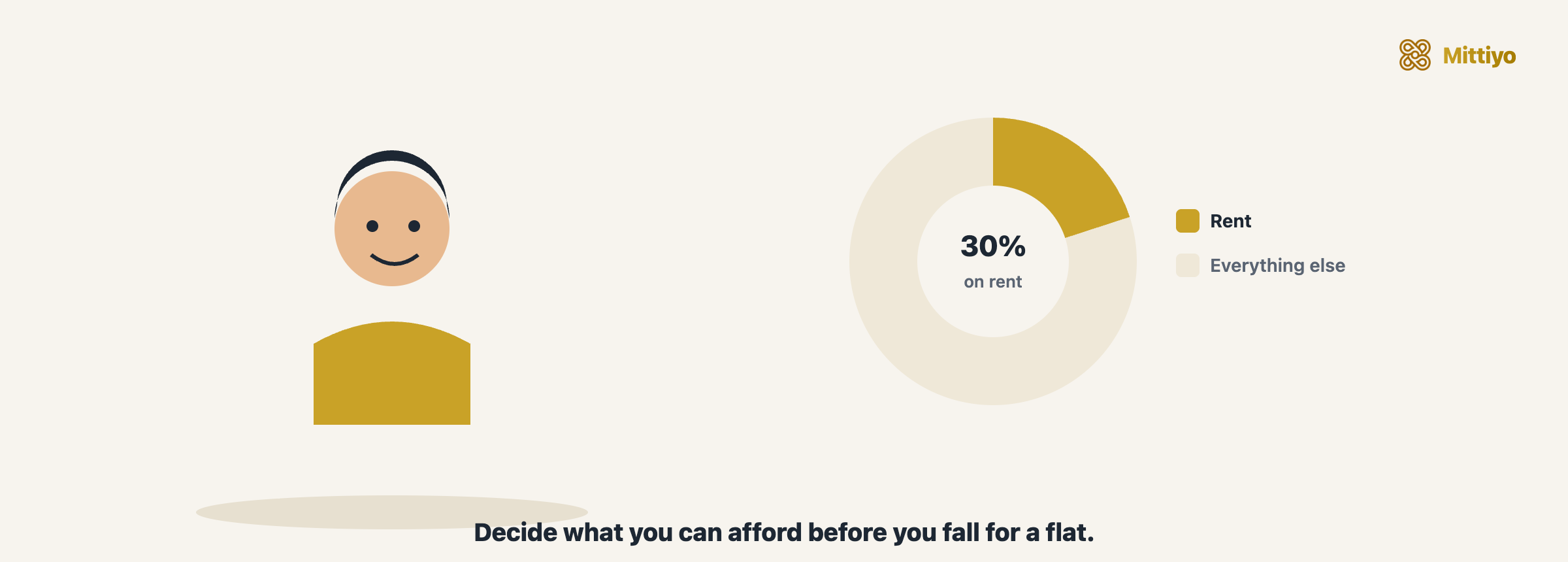
The 30% rule
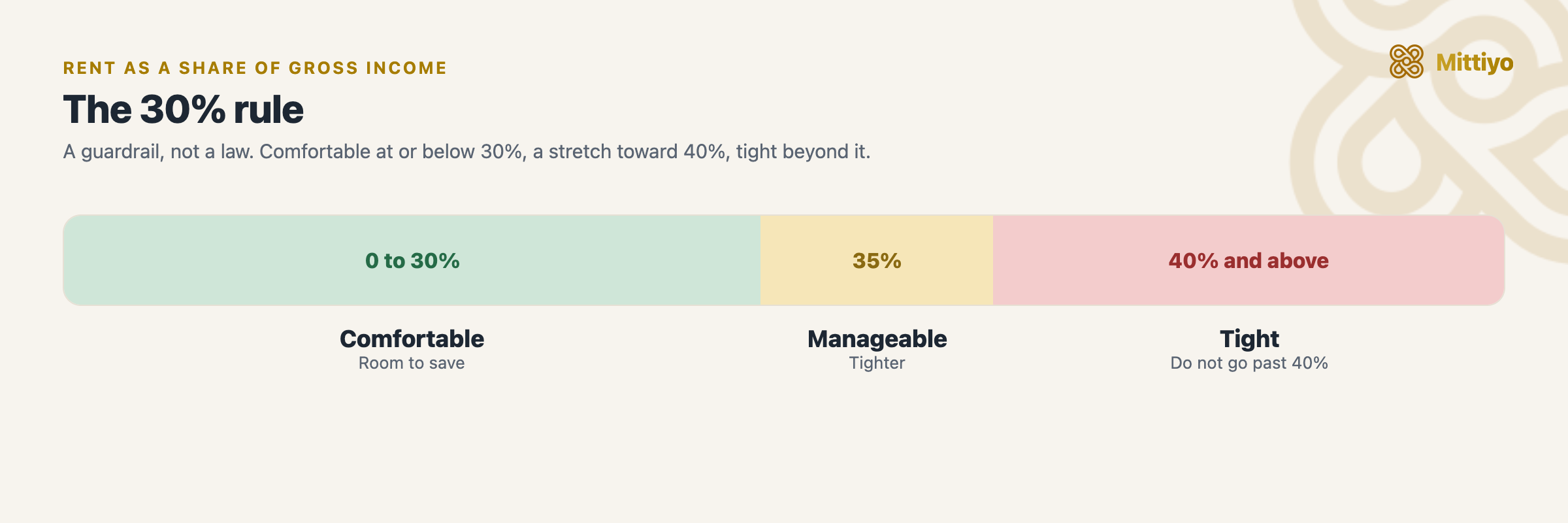 A guardrail, not a law: comfortable at or below 30%, a stretch toward 40%, tight beyond it.
The rule is easy: keep rent at or below about 30% of your gross (pre-tax) monthly income. On a monthly income of 5,000, that is around 1,500 in the same currency. It is a rough ceiling, not a precise budget, but it is a good sanity check:
- At or below 30%: comfortable, with room to save.
- Around 35 to 40%: manageable, but tighter, common in expensive cities.
- Above 40%: money will feel tight, and unexpected costs will hurt.
If you must go above 30%, do it deliberately, cut other spending, keep an emergency fund, and treat 40% as a firm upper limit.
This trips people up. The 30% rule uses your gross income, the figure before tax and deductions. The 50/30/20 budget uses your take-home (net) pay, what actually lands in your account.
That is not a contradiction, they are two different lenses. But it means you cannot mix them: applying 30% to your take-home pay gives a lower, more conservative rent, and applying 50/30/20 to your gross income overstates what you can spend. Where tax and deductions are heavy, the gross-based 30% figure can flatter you, so if your take-home is much lower than your gross, lean on the 50/30/20 cross-check.
The 30% guideline is not arbitrary. Housing agencies have used it for decades as the line above which a household is considered “cost-burdened”, the US Department of Housing and Urban Development, for instance, defines families who pay more than 30% of income on housing as cost-burdened. That is why it is a useful ceiling, not a target.
Your number: the interactive calculator
Use the interactive calculator below. Type your monthly income into the field and the three rent figures update instantly, there is nothing to submit and no sign-up. It works in any currency, because the percentages are the same everywhere.
Enter an amount above and these three figures fill in for your income.
Guideline only. Enter figures in your own currency; the percentages are the same worldwide.
The comfortable figure (30%) is your target; the 40% figure is a line not to cross.
The fuller picture: the 50/30/20 budget
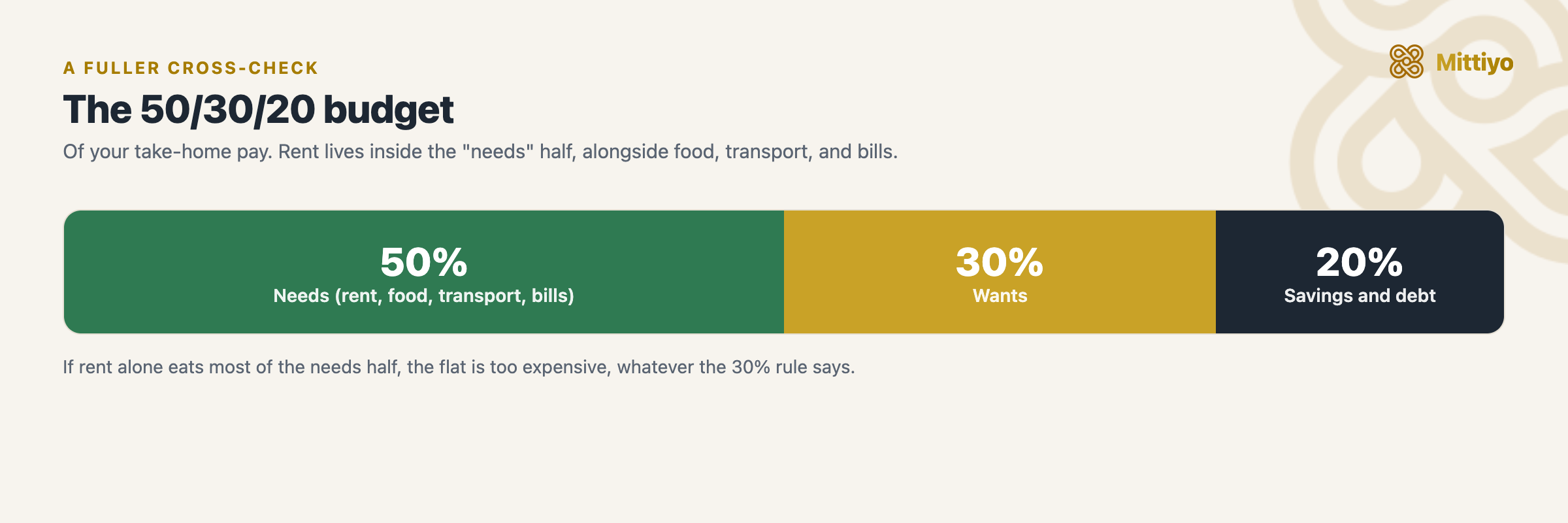 Rent lives inside the “needs” half, alongside food, transport, and bills.
The 30% rule looks at rent alone. The 50/30/20 budget puts it in context, using your take-home (post-tax) pay:
- 50% on needs, rent, food, transport, utilities, insurance.
- 30% on wants, dining out, entertainment, subscriptions.
- 20% on savings and debt repayment.
Since rent sits inside the 50% “needs” bucket alongside your other essentials, this is a useful cross-check: if rent alone eats most of your needs budget, the flat is too expensive, whatever the 30% rule says.
The costs beyond rent
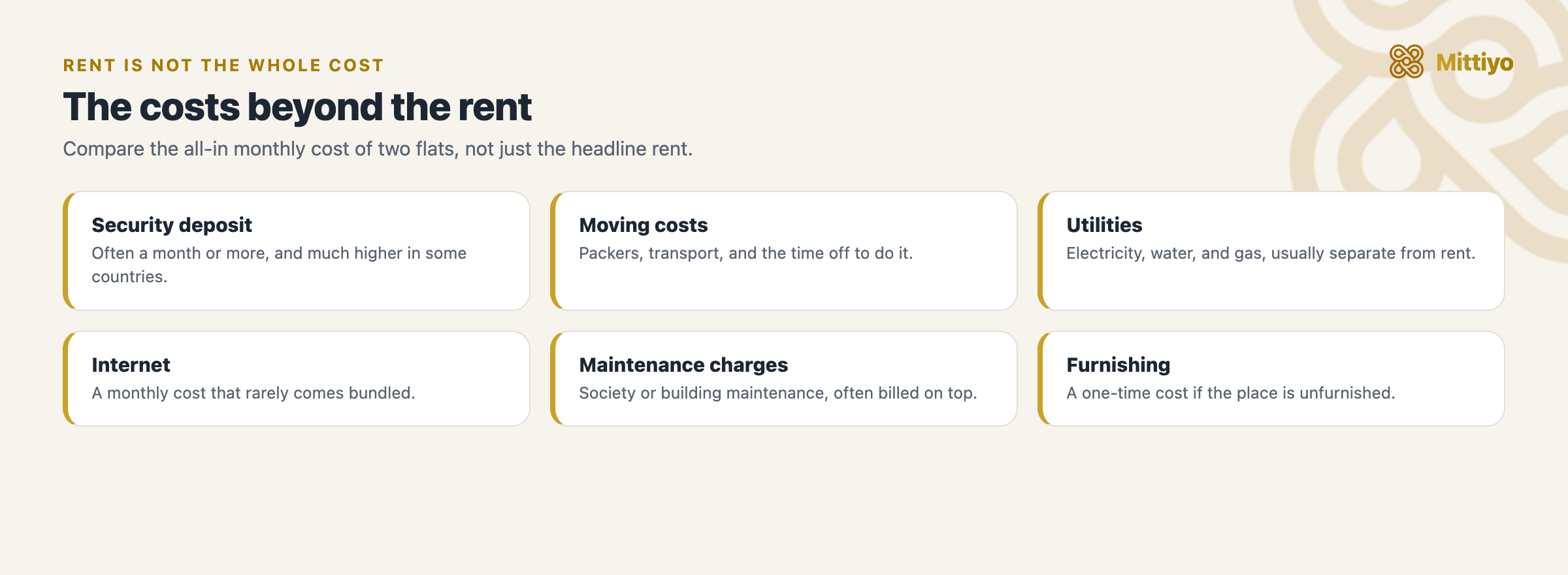 Compare the all-in monthly cost of two flats, not just the headline rent.
The rent number is not the whole cost. Budget also for:
- The security deposit, often a month or more, and much higher in some countries.
- Moving costs and, for an unfurnished place, furnishing it.
- Utilities (electricity, water, gas), internet, and any maintenance or society charges not included in rent.
When you compare two flats, compare the all-in monthly cost. A cheaper rent with high maintenance and utilities can cost more than a pricier all-inclusive one.
The 30% rule tells you what you can pay each month. It does not tell you what you need on day one, and that upfront number surprises people. A rough picture for a place renting at 1,000 a month:
- First month’s rent: 1,000
- Security deposit: 1,000 or more (much higher in some countries, several months’ rent)
- Moving and basic setup: roughly 500
That is around 2,500 before you have lived there a single night, and more if the flat is unfurnished and you have to buy furniture. Save the move-in cash before you commit, not just the monthly rent.
How landlords judge affordability
Landlords and agents often use an income multiple. A common one: your gross annual income should be at least 40 times the monthly rent (which is the same as rent being about 30% of gross income). Some ask for monthly income of 2.5 to 3 times the rent. They may want pay slips, an employment letter, or bank statements as proof, and sometimes a guarantor if you fall short or have no local rental history. Knowing the multiple they use helps you target places you will actually qualify for.
Key takeaways
- Aim for rent at or below 30% of gross income; treat 40% as a firm upper limit.
- Cross-check with the 50/30/20 budget: rent plus other needs should stay within 50% of take-home pay.
- Budget for the deposit, moving, utilities, internet, and maintenance, compare the all-in cost.
- Expensive cities often break the 30% rule; if you spend more, do it deliberately and keep a cushion.
- Landlords often want income of about 40 times the monthly rent a year, so target places you qualify for.
Your budget is half the story. What a building really costs is the other half.
Two flats at the same rent can cost very differently once you count maintenance, utilities, and the repairs a landlord ignores. Wherever you rent, know.place maps honest, building-level rental experiences from real residents, so you can see what a building actually costs to live in, not just its headline rent, and add your own experience for the next person.
Explore know.placeRelated guides: Apartment viewing checklist · Questions to ask a landlord before you rent · How to spot a rental scam
This is general budgeting guidance, not personalised financial advice; adjust the numbers to your own income, debts, and city.
More tools: All free renter tools
References
- HUD USER glossary (housing cost burden), Office of Policy Development and Research, US Department of Housing and Urban Development (households paying more than 30% of income on housing are considered cost-burdened)