

Missouri keeps its security deposit rules short, which is part of what makes them easy to use: a hard cap on how much a landlord can charge, a firm 30-day return window, a real right to be present at the move-out inspection, and double damages if a landlord ignores any of it. This guide walks through the statute section by section.
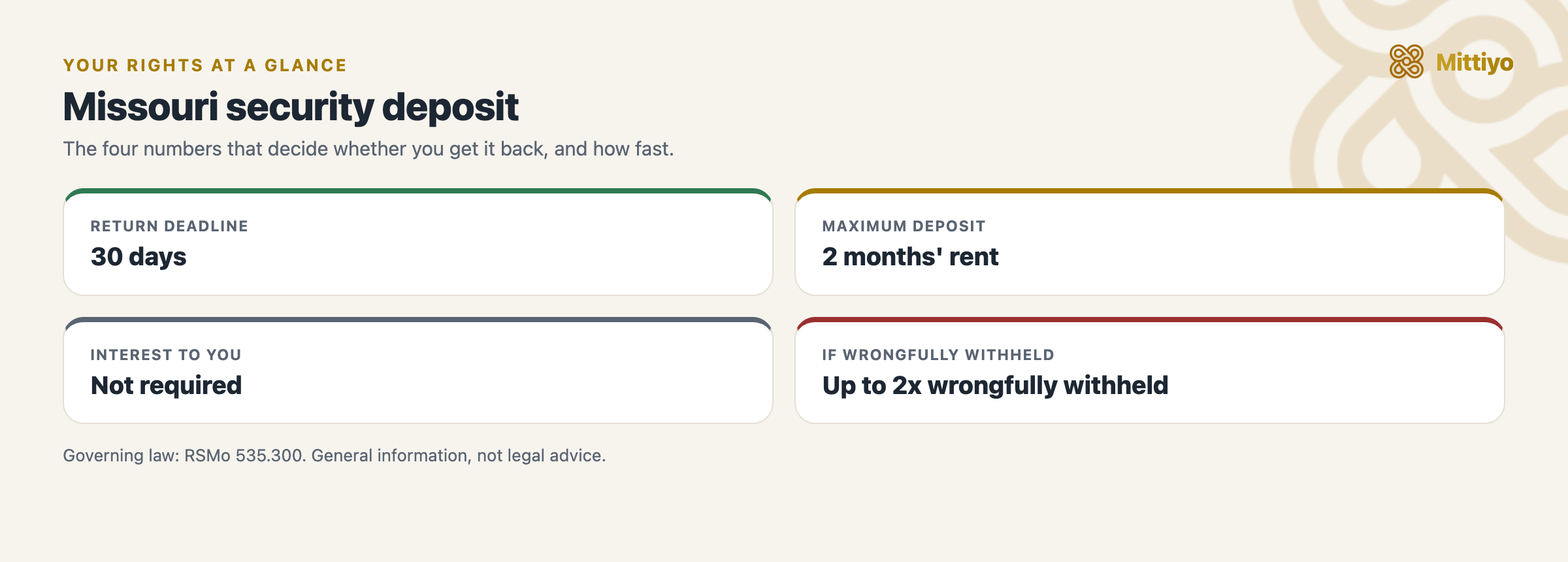
TL;DR: A Missouri landlord cannot charge more than two months’ rent as a deposit. After you move out, they have 30 days to return it in full or send a written itemized list of damages with the balance. You have the right to written notice of the move-out inspection and to be present for it. Miss the deadline or withhold without cause, and the landlord owes you up to double the amount wrongfully kept.
The move-out inspection notice: Missouri’s most underused protection
Before a landlord decides what to withhold, RSMo 535.300.4 requires them to give you or your representative reasonable written notice of the date and time they will inspect the unit after the tenancy ends. The notice goes to your last known address or to you in person. The inspection has to happen at a reasonable time, and you have the right to be present.
Most tenants never ask whether this happened. A landlord who withholds money without notifying you of an inspection, or without actually inspecting the unit, has a much weaker basis for the deduction. If that describes your move-out, say so explicitly in your demand letter.
A $1,200 deposit and a $400 deduction: how the inspection point plays out
Say your deposit was $1,200 on a $600-a-month rental (two months’ rent, the statutory maximum). You move out, and 30 days pass with no refund and no itemized list.
Because the landlord missed the deadline entirely, you can pursue the full $1,200, and because Missouri courts read 535.300 strictly, a missed deadline is a straightforward violation to prove. If the landlord instead sent a list withholding $400 for what was actually normal wear and tear, that $400 is wrongfully withheld, and you can recover up to twice that amount, $800, in addition to getting back what was legitimately yours.
The 30-day clock starts when your tenancy ends
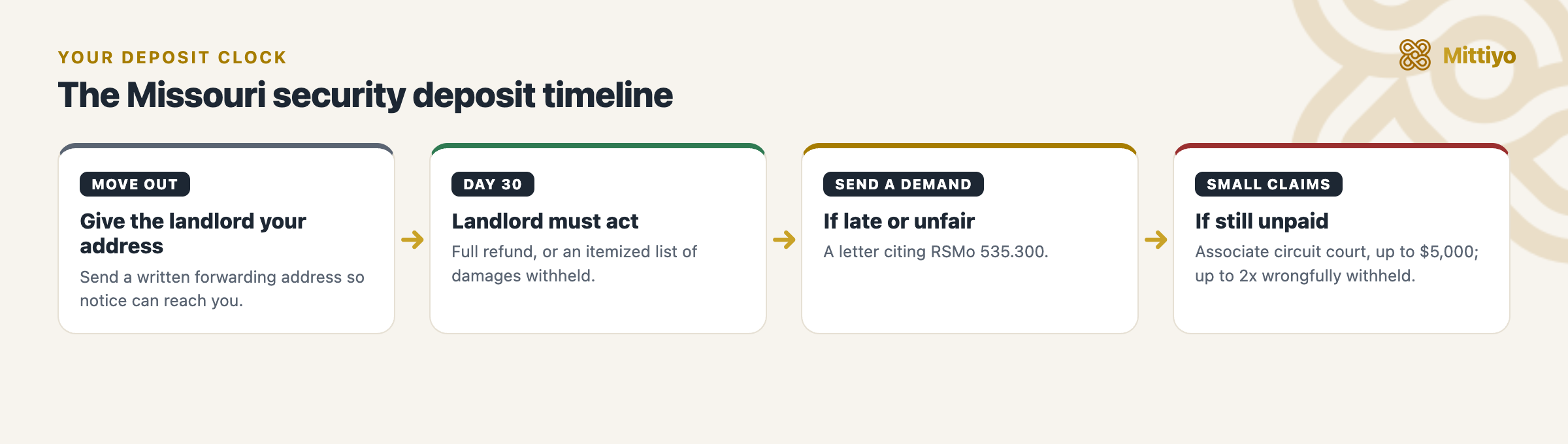
Under RSMo 535.300.2, the landlord has 30 days after the date your tenancy ends to either return the full deposit, or furnish you a written itemized list of the damages for which all or part of the deposit is being withheld, along with whatever balance remains. The landlord satisfies this by mailing the statement and any payment to your last known address, so keep your forwarding address current with them.
The two-month ceiling, checked before you pay
RSMo 535.300.1 is explicit: “A landlord may not demand or receive a security deposit in excess of two months’ rent.” There is no separate allowance for pet deposits or extra fees under this section; whatever a landlord collects under the label of a security deposit is capped at two months, full stop.
A landlord who charged more was already out of compliance when they took your money, which strengthens your position in any later dispute.
Deductions that hold up, and ones that do not
RSMo 535.300.3 lets a landlord withhold only amounts reasonably necessary to remedy unpaid rent, to restore the unit to its condition at the start of the tenancy (ordinary wear and tear excepted), or to compensate for actual damages from inadequate notice to terminate, provided the landlord made reasonable efforts to mitigate by re-renting.
Double damages under 535.300.5
The statute is direct: “If the landlord wrongfully withholds all or any portion of the security deposit in violation of this section, the tenant shall recover as damages not more than twice the amount wrongfully withheld.” A missed 30-day deadline, an unlawful deduction, or both can trigger it, and Missouri courts have read the statute as strict consumer protection, so there is little room for a landlord to argue substantial compliance.
The statute also preserves the landlord’s right to pursue actual damages beyond the deposit, and it does not let a tenant apply the deposit to rent in lieu of payment, so treat the deposit and your rent obligations as separate through the end of the tenancy.
No interest and no separate account
Missouri does not require a landlord to pay interest on your deposit, no matter how long it is held. Unlike some states, Missouri also does not require the deposit to sit in a dedicated trust or escrow account, so there is no separate disclosure to expect on that front. Your main protections are the cap, the deadline, and the inspection notice.
Demand letter first, then the associate circuit court
Send a written demand before you file anything; it often settles the matter by itself. Fill in the tool below and it drafts the letter for you.
Fill in your details and the letter below updates live. Copy it, then paste into an email or print and post it.
[Date]

To: [Landlord name and address]

Re: Return of security deposit, [rental address]

To whom it may concern,

I rented [rental address] and moved out on [move-out date], returning possession and giving my forwarding address at [your forwarding address]. Under Missouri's security deposit statute (RSMo 535.300), you had 30 days to return my [$ amount] security deposit with a written itemized list of any damages withheld. That deadline has passed.

Please return the [$ amount] you owe me within 10 days of this letter. If you do not, I will file in small claims division of the associate circuit court for the deposit plus damages of up to twice the amount wrongfully withheld, as allowed by RSMo 535.300.5.

Sincerely,
[Your name]
This is a template to adapt, not legal advice. Keep a copy and send it so you can prove delivery (email, or post with tracking).
If the letter gets no result, the next step is the small claims division of the associate circuit court under RSMo 482.305. An individual can sue for up to $5,000, which comfortably covers most deposits plus double damages. Small claims is built for people without a lawyer, and filing fees typically run $35 to $45 depending on the county.
Bring your lease, proof you paid the deposit, dated move-in and move-out photos, the landlord’s itemized statement (or proof none arrived), any written notice of the move-out inspection you received (or did not), and your demand letter.
Your move-out sequence
Give the landlord your forwarding address in writing, since the statement and refund go to your last known address. Watch for the inspection notice and attend if you can. Count 30 days from the end of the tenancy. If the deadline passes or a deduction looks wrong, cite RSMo 535.300 in your demand, then file in small claims if it stays unpaid. If the original deposit exceeded two months’ rent, raise that as a separate violation.
Key takeaways
- The inspection notice under 535.300.4 is the protection tenants most often miss: written notice, a reasonable time, and your right to be there.
- The landlord has 30 days after your tenancy ends to return the deposit in full or send an itemized statement with the balance.
- Wrongful withholding lets you recover up to twice the amount improperly kept.
- Missouri caps the deposit at two months’ rent; more than that already violates the statute.
- Missouri requires no interest on the deposit and no separate trust account.
- Deposit claims go to the small claims division of the associate circuit court, with a $5,000 limit.
This guide is general information, not legal advice; landlord-tenant rules change and can vary by city, so confirm against the sources below or a local attorney. Last reviewed July 2026.
Renting somewhere new?
know.place maps honest, structured experiences of specific buildings, the rent, deposit, water, and power, from people who have actually lived there, so you can vet a place before you sign.
Related: Security deposit laws by state · How much rent can you afford? · Apartment viewing checklist
Free tools: Deposit interest calculator · Notice to vacate generator
Sources
- RSMo 535.300, security deposits: https://law.justia.com/codes/missouri/2015/title-xxxvi/chapter-535/section-535.300
- RSMo 482.305, small claims jurisdiction: https://law.justia.com/codes/missouri/title-xxxii/chapter-482/section-482-305/
- FindLaw, Missouri Small Claims Courts: https://www.findlaw.com/state/missouri-law/missouri-small-claims-courts.html
- Missouri Legal Services, security deposits: https://www.lsmo.org/node/652/security-deposits