

Nevada’s deposit rules combine a hard three-month cap with an unusual two-part penalty: a landlord who wrongfully keeps your money does not just owe you the deposit back, a court can add on up to another full deposit’s worth on top of that, based on how they behaved. This guide starts with what Nevada treats as a deposit, because that definition drives everything else.
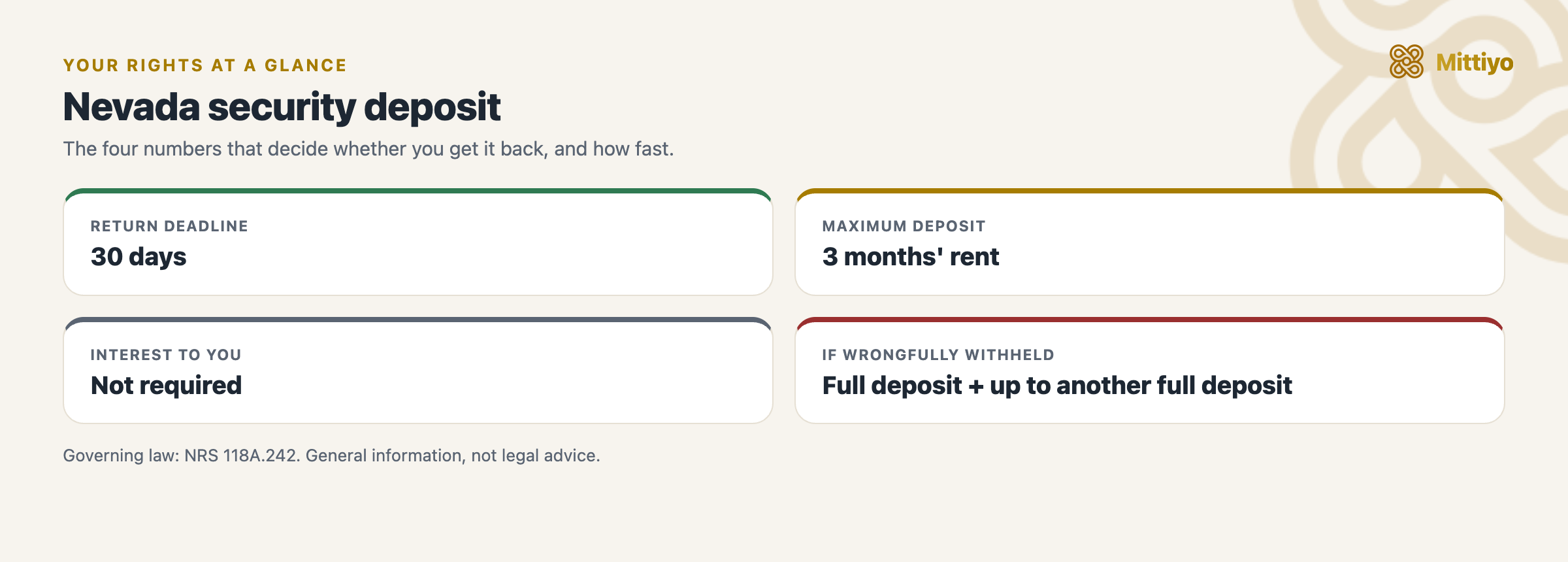
TL;DR: A Nevada landlord cannot hold more than three months’ rent total across your deposit, any surety bond, and last month’s rent. After you move out, they have 30 days to send an itemized accounting and return what they are not claiming. If they fail to, you can recover the full deposit plus a court-determined amount up to another full deposit, so up to double in total.
What counts as a deposit, and what a lease cannot call one
Under NRS 118A.242(8), no rental agreement may call a security deposit nonrefundable, or waive or modify your rights under this section, and any clause that tries is void as against public policy. The one carve-out is a separate, clearly labeled, reasonable nonrefundable cleaning charge, which is treated differently from the deposit itself.
That ban matters because Nevada groups several kinds of money into one pool. A security deposit, a surety bond, and last month’s rent held under either label are all counted together. Renaming a payment does not move it outside the rules. Nevada also does not require interest on a residential security deposit.
One cap for the whole pool
The limit is three months’ periodic rent, combined. NRS 118A.242(1) caps the total of any security deposit and surety bond, including last month’s rent held under either label, at three months’ rent altogether. A landlord cannot get around this by splitting the charge across a “deposit” and a separate “last month’s rent” that together exceed the cap; the statute treats them as one pool.
Subsection (2) lets you purchase a surety bond instead of paying all or part of a cash deposit, but only if your landlord agrees to it. The landlord is free to decline a bond, and separately cannot require you to buy one instead of paying a deposit in cash, under subsection (3).
Thirty days from the end of the tenancy
Once your tenancy ends, the landlord has 30 days. Under NRS 118A.242(4), within that window the landlord must give you an itemized written accounting of how the deposit was used, and return whatever remains, either handed to you personally where rent is paid or mailed to your current address, or your last known address if the current one is unavailable.
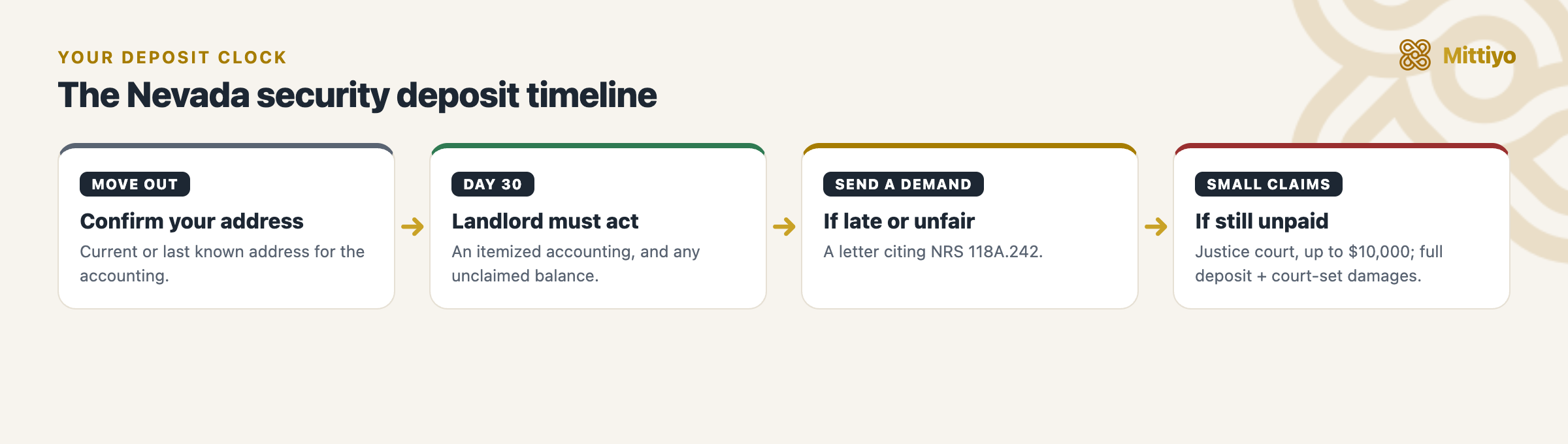
Give the landlord your current address when you move out, so the accounting and any refund can reach you.
The three permitted deductions
NRS 118A.242(4) allows a landlord to claim only amounts reasonably necessary for three things:
- unpaid rent
- repair of damage you caused beyond normal wear and tear
- the reasonable cost of cleaning the unit
Entire deposit plus a court-set sum
If the landlord fails or refuses to return the remainder of your deposit within 30 days, NRS 118A.242(6) gives you a two-part remedy: damages equal to the entire security deposit, plus a further sum fixed by the court, capped at another full deposit amount. Subsection (7) tells the court what to weigh in setting that second amount: whether the landlord acted in good faith, the course of conduct between you and the landlord, and the degree of harm the landlord’s conduct caused you. A landlord who simply ignored the deadline with no explanation is in a much weaker position than one who made a good-faith but ultimately incorrect deduction.
If you used a surety bond instead of a cash deposit and dispute an item in the accounting, subsection (5) gives you a separate 30-day window to send a written response to the surety company, which then cannot report the landlord’s claim to a credit reporting agency unless the surety wins a judgment against you.
Example: a $1,500 deposit and no reply
Say your deposit was $1,500 on a $750-a-month rental (two months’ rent, within the three-month cap). You move out, and 30 days pass with no accounting and no refund at all.
Under NRS 118A.242(6), you can recover the entire $1,500 as damages for the missed deadline. On top of that, the court can set an additional sum, up to another $1,500, considering whether the landlord acted in good faith, the course of conduct between you, and how much harm the delay caused you. In a straightforward case where the landlord simply never responded, that could mean recovering close to $3,000 total on a $1,500 deposit. This two-part structure, entire deposit plus a separate court-set amount, is more nuanced than the flat doubling rule most states use, so do not assume it is automatically exactly double; it depends on what the court finds.
Demand first, then Justice Court
A written demand is worth sending before you file anything. If the deadline passes or a deduction looks wrong, cite NRS 118A.242 in it. Fill in the tool below and it drafts the letter for you.
Fill in your details and the letter below updates live. Copy it, then paste into an email or print and post it.
[Date]

To: [Landlord name and address]

Re: Return of security deposit, [rental address]

To whom it may concern,

I rented [rental address] and moved out on [move-out date], returning possession and giving my forwarding address at [your forwarding address]. Under Nevada's security deposit statute (NRS 118A.242), you had 30 days to return my [$ amount] security deposit with an itemized written accounting of any deductions. That deadline has passed.

Please return the [$ amount] you owe me within 10 days of this letter. If you do not, I will file in small claims department of the Justice Court for the entire deposit plus an additional court-determined sum of up to another full deposit amount, as allowed by NRS 118A.242(6).

Sincerely,
[Your name]
This is a template to adapt, not legal advice. Keep a copy and send it so you can prove delivery (email, or post with tracking).
Should the letter go unanswered, take the dispute to the small claims department of your local Justice Court under NRS Chapter 73. The limit is $10,000, which comfortably covers most deposits even with the added damages, and you do not need a lawyer; file in the township where the landlord lives or where the tenancy was located.
Bring your lease, proof of the deposit you paid, dated move-in and move-out photos, the landlord’s itemized accounting (or proof none arrived), and your demand letter.
Nevada’s rules in brief
| Rule | Nevada |
|---|---|
| Nonrefundable deposit | Void as against public policy; narrow exception for a separate, clearly labeled, reasonable cleaning charge |
| Cap | Three months’ rent total, across deposit, surety bond, and last month’s rent |
| Return deadline | 30 days after the tenancy ends, with an itemized written accounting |
| Interest | Not required |
| Wrongful withholding | Entire deposit plus a court-set sum of up to another full deposit |
| Where to sue | Small claims department of the Justice Court, $10,000 limit |
This guide is general information, not legal advice; landlord-tenant rules change and can vary by city, so confirm against the sources below or a local attorney. Last reviewed July 2026.
Renting somewhere new?
know.place maps honest, structured experiences of specific buildings, the rent, deposit, water, and power, from people who have actually lived there, so you can vet a place before you sign.
Related: Security deposit laws by state · How much rent can you afford? · Apartment viewing checklist
Free tools: Deposit interest calculator · Notice to vacate generator
Sources
- NRS 118A.242, security deposit limitation, damages, disputes: https://law.justia.com/codes/nevada/chapter-118a/statute-118a-242/
- Nevada Administrative Office of the Courts, small claims: https://nvcourts.gov/aoc/discover_nevada_justice/small_claims_court