

Tennessee’s security deposit rules are genuinely different from most of the country in two ways: they only apply in the state’s larger counties, and they do not run on a fixed “return within X days” deadline the way nearly every other state does. Most online guides flatten Tennessee into a generic “30-day rule” state. It is not one, and knowing the real mechanism matters if you actually need to use it.
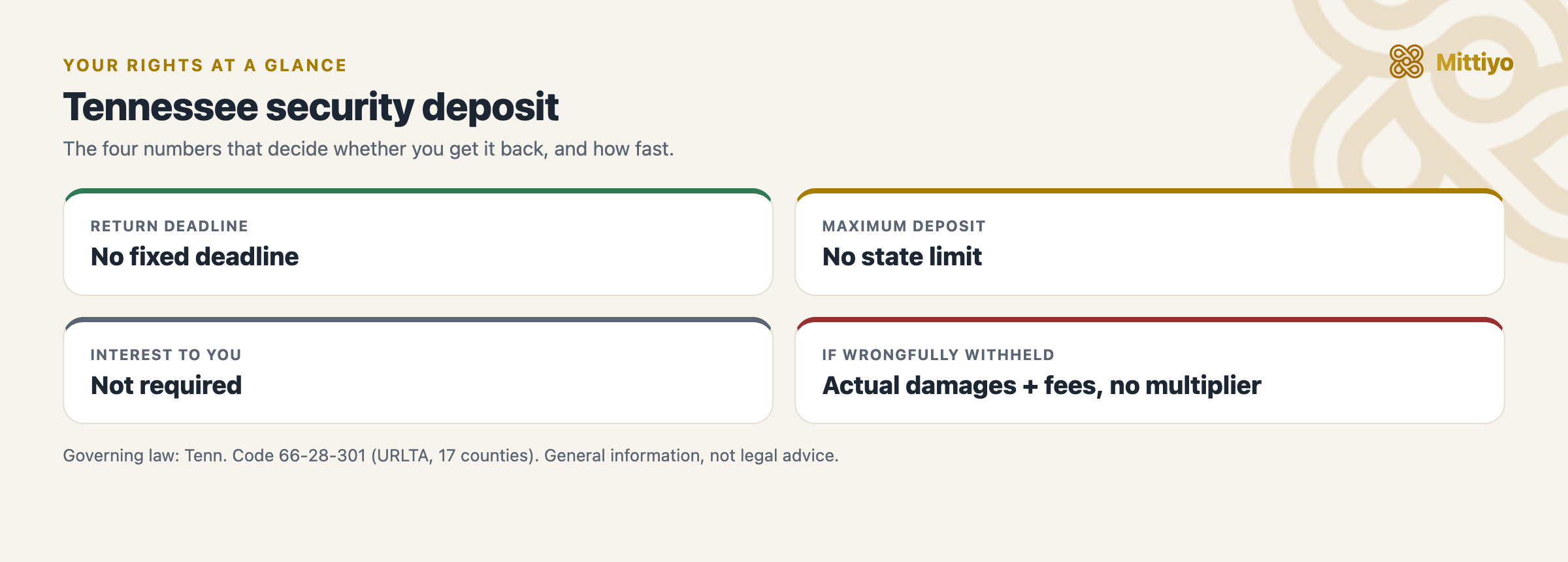
TL;DR: Tennessee’s deposit law, the URLTA, only covers counties with more than 75,000 people, which includes Nashville, Memphis, Knoxville, Chattanooga, and most other population centers. Where it applies, there is no fixed refund deadline: the landlord sends you notice of any refund due, and you have 60 days to respond before they can keep it. You are entitled to a move-out inspection, and the landlord forfeits the right to withhold anything only if they both skipped the required deposit account and skipped the damage listing.
Step one: does the URLTA cover your county?
Every other question depends on this one, and most Tennessee deposit guides skip it. The Uniform Residential Landlord and Tenant Act, codified at Tenn. Code 66-28-301, applies only in counties that had a population over 75,000 in the 2010 federal census. As of today, that is 17 counties: Anderson, Blount, Bradley, Davidson, Hamilton, Knox, Madison, Maury, Montgomery, Rutherford, Sevier, Shelby, Sullivan, Sumner, Washington, Williamson, and Wilson.
That list covers Nashville (Davidson), Memphis (Shelby), Knoxville (Knox), Chattanooga (Hamilton), and most of the state’s renters by population, even though it is a minority of Tennessee’s 95 counties by count. Where the URLTA applies, local governments cannot pass their own conflicting ordinances on top of it. If you rent in a smaller county outside this list, a different and generally thinner set of rules under Title 66, Chapter 7 applies instead, so check your county before relying on anything below.
If you are covered: no cap, but a dedicated account
The URLTA sets no statewide cap on the deposit amount. Whatever your lease specifies is what applies, subject to the account and inspection rules that follow.
Under Tenn. Code 66-28-301(a), a landlord who requires a deposit must hold it in a dedicated account at a bank or lending institution, used only for that purpose, and must tell you where that account is located when you sign the lease and pay the deposit, though not the account number itself.
Your right to be present at move-out
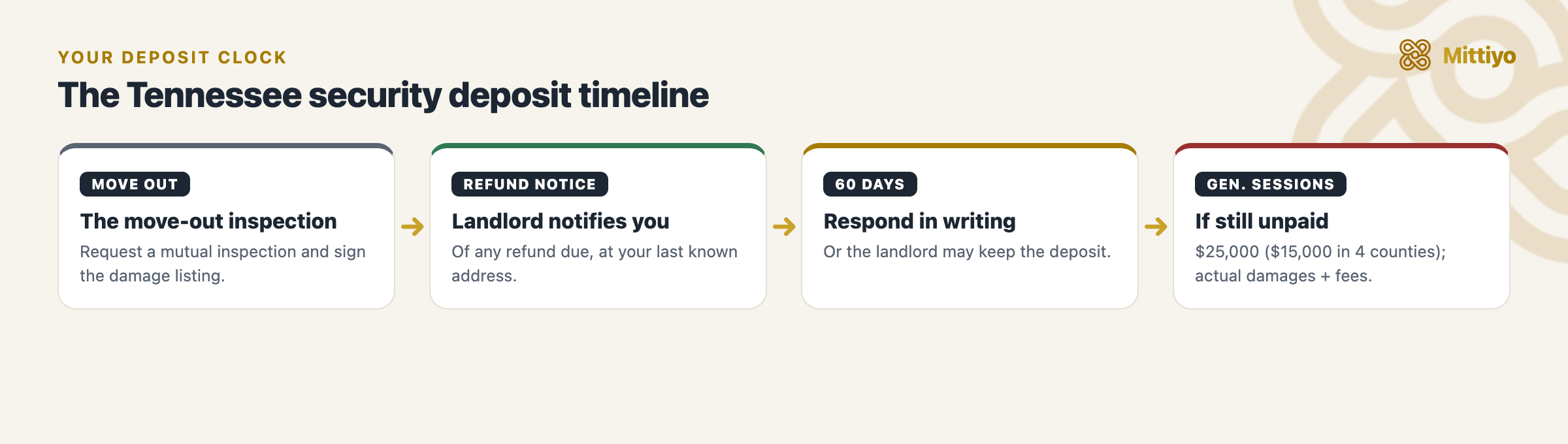
At move-out, you generally have the right to a mutual inspection. Under subsection (b), the landlord notifies you of your right to be present, either when they ask you to vacate or within 5 days of your written notice of intent to leave, and the inspection has to happen on the day you vacate or within 4 calendar days after. If you request the inspection, you and the landlord compile and sign a listing of any damage and its estimated repair cost. Your signature on that listing is treated as conclusive evidence of its accuracy, so read it carefully and note in writing anything you disagree with before you sign.
A refund with no due date: notice, then 60 days
Here Tennessee departs from nearly every other state. No statute says the landlord has 30 or 45 days to send your money back. Under subsection (f), if you leave owing no rent and a refund is due, the landlord sends notice of the refund amount to your last known or reasonably determinable address. If the landlord does not hear back from you within 60 days of sending that notice, they may remove the deposit from the account and keep it free of any claim from you.
The practical result is that the burden sits on you. Once the notice arrives, respond in writing, even just to confirm your address and dispute the amount if it looks wrong. If no notice ever arrives, that is itself worth raising, since the statute requires the landlord to send one.
If you leave owing rent or other amounts, the landlord can apply the deposit to that debt directly under subsection (e), without going through the refund-notice process.
Davidson County, $1,100 held, $700 offered back
Say you rent in Davidson County (Nashville, URLTA-covered) with an $1,100 deposit. You move out owing no rent, and the landlord sends a notice to your last known address saying $700 is due back, after deducting for a damaged blind you disagree was your responsibility.
You have 60 days from that notice to respond in writing disputing the $700 figure, pointing to the signed move-out listing (or the lack of one) and explaining why the deduction is not valid. If the landlord never held your deposit in the required account and never gave you a damage listing at all, both conditions have to be true, they forfeit the right to withhold anything, and you can pursue the full $1,100.
What the landlord may deduct, and for how long
A landlord can deduct for unpaid rent and for physical damage identified through the move-out inspection listing, beyond normal wear and tear. A separate, narrower window exists under subsection (g): the landlord can pursue newly discovered physical damage, found after the initial inspection, only if it is discovered within 30 days of you vacating or 7 days after a new tenant moves in, whichever comes first.
Forfeiture takes two failures, and interest is not owed
Tennessee’s URLTA does not require interest on a residential deposit. The forfeiture rule in subsection (c) is also narrower than in most states: the landlord loses the right to retain any portion of the deposit only if both conditions are true, the deposit was not held in the required account, and no damage listing was provided. If the landlord did either one correctly, deductions can still stand, which is why documenting both is worth doing early.
Remedy: actual damages and fees after a 14-day cure notice
The general URLTA remedy is in Tenn. Code 66-28-501. You can recover actual damages, injunctive relief, and reasonable attorney’s fees for the landlord’s noncompliance with the rental agreement or the chapter, but you generally must give the landlord 14 days’ written notice specifying the breach, so they have a chance to fix it, before you can pursue the remedy. Tennessee does not attach a doubling or tripling multiplier to deposit violations the way many other states do; the remedy is actual damages plus fees, not a statutory bonus.
From written dispute to General Sessions Court
Given the 60-day window, your written response to the refund notice is the most useful paper you will produce, and a follow-up demand backs it up. Fill in the tool below and it drafts the letter for you.
Fill in your details and the letter below updates live. Copy it, then paste into an email or print and post it.
[Date]

To: [Landlord name and address]

Re: Return of security deposit, [rental address]

To whom it may concern,

I rented [rental address] and moved out on [move-out date], returning possession and giving my forwarding address at [your forwarding address]. Under Tennessee's Uniform Residential Landlord and Tenant Act (Tenn. Code 66-28-301), you had 60 days to respond to the landlord's refund notice to return my [$ amount] security deposit, disputing the amount and citing the signed move-out damage listing. That deadline has passed.

Please return the [$ amount] you owe me within 10 days of this letter. If you do not, I will file in General Sessions Court for the deposit plus actual damages and reasonable attorney's fees after 14 days' written notice to cure, as allowed by Tenn. Code 66-28-501.

Sincerely,
[Your name]
This is a template to adapt, not legal advice. Keep a copy and send it so you can prove delivery (email, or post with tracking).
If the response and demand do not settle it, deposit disputes in URLTA counties go to General Sessions Court. The general limit is $25,000, though it drops to $15,000 in Anderson, Davidson, Hamilton, and Knox counties specifically, which overlaps with three of the state’s most populous URLTA counties. You do not need a lawyer to file.
Take your lease, proof of the deposit you paid, the signed move-out damage listing (or proof one was never offered), the landlord’s refund notice and your written response, and dated move-in and move-out photos.
Key takeaways
- Tennessee’s URLTA deposit rules apply only in 17 counties over 75,000 population, covering Nashville, Memphis, Knoxville, and Chattanooga among them.
- There is no fixed refund deadline; instead, the landlord sends a refund notice, and you have 60 days to respond before they can keep the money.
- Full forfeiture of the landlord’s withholding right requires both a missing deposit account and a missing damage listing, not just one.
- No cap and no interest requirement apply under state law.
- The remedy for noncompliance is actual damages plus attorney’s fees, not a doubling or tripling penalty, and generally requires 14 days’ written notice to cure first.
- Deposit disputes go to General Sessions Court, $25,000 statewide or $15,000 in Anderson, Davidson, Hamilton, and Knox counties.
This guide is general information, not legal advice; landlord-tenant rules change and can vary by county, so confirm against the sources below or a local attorney. Last reviewed July 2026.
Renting somewhere new?
know.place maps honest, structured experiences of specific buildings, the rent, deposit, water, and power, from people who have actually lived there, so you can vet a place before you sign.
Related: Security deposit laws by state · How much rent can you afford? · Apartment viewing checklist
Free tools: Deposit interest calculator · Notice to vacate generator
Sources
- Tenn. Code 66-28-301, security deposits: https://law.justia.com/codes/tennessee/title-66/chapter-28/part-3/section-66-28-301/
- Tenn. Code 66-28-501, noncompliance with rental agreement by landlord: https://law.justia.com/codes/tennessee/title-66/chapter-28/part-5/section-66-28-501/
- Tenn. Code Title 66, Chapter 28, Uniform Residential Landlord and Tenant Act: https://law.justia.com/codes/tennessee/title-66/chapter-28/