

Wisconsin builds its deposit protections around documentation, both at the start of your tenancy and at the end. Get the check-in disclosure right and you have a record of the unit’s condition before you ever move in a box; get the 21-day deadline right and a landlord who ignores it owes you double the amount plus attorney fees they cannot avoid paying. This guide walks through both halves.
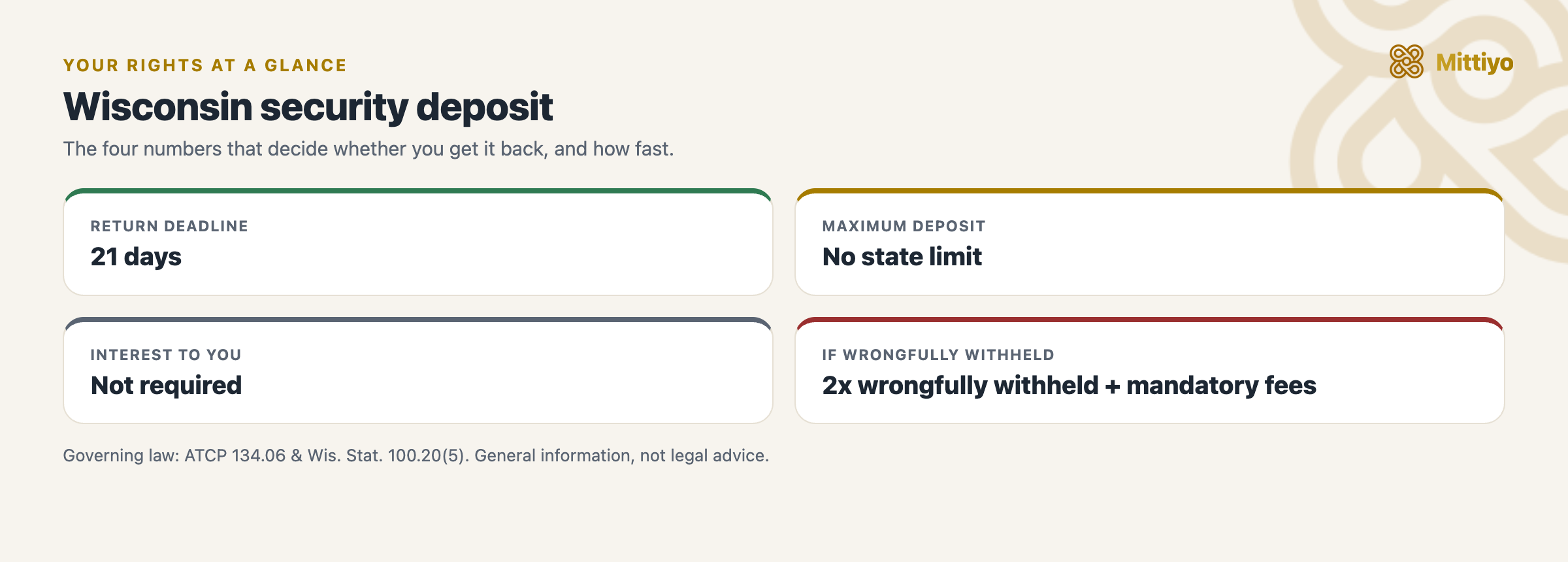
TL;DR: A Wisconsin landlord must offer you, in writing before taking your deposit, the chance to inspect the unit and see any damages charged to the last tenant. After you move out, they have 21 days to return your deposit or send an itemized statement of deductions. Miss it, and you can recover double the amount wrongfully withheld plus attorney fees, which Wisconsin courts treat as mandatory once you win.
Before you sign: the written check-in disclosure
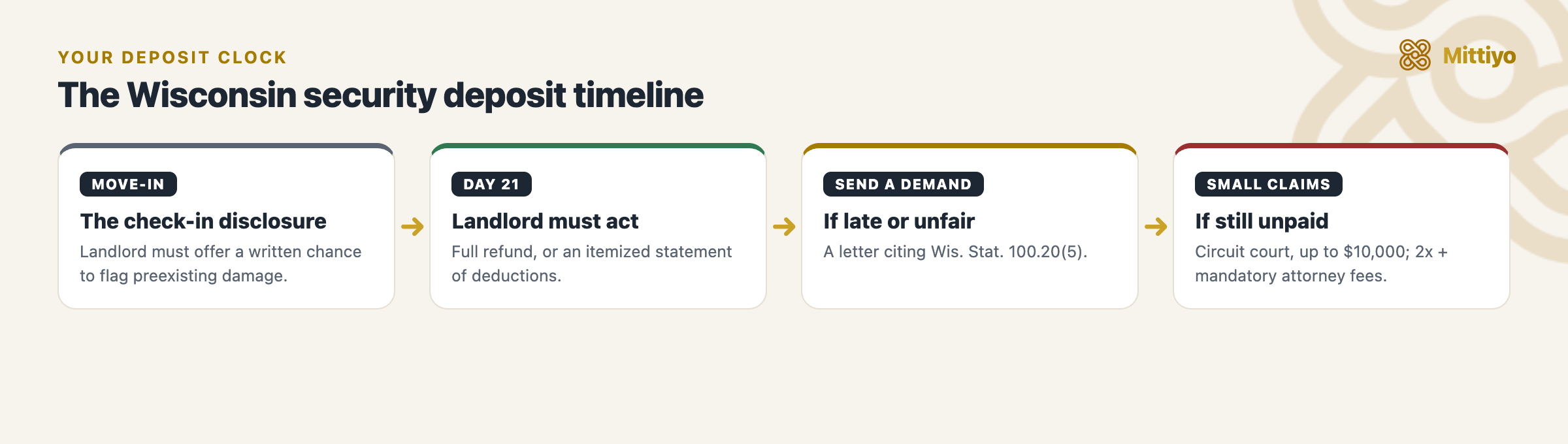
Wisconsin’s rules start before your tenancy does. Under ATCP 134.06(1), before a landlord accepts a security deposit, they must notify you in writing that, by a deadline no earlier than 7 days after your tenancy starts, you may inspect the unit and tell the landlord about any preexisting damage, and you may request a list of any physical damages or defects that were charged against the previous tenant’s deposit. If you ask for that list, the landlord has to provide it within 30 days of your request, though they do not have to name the previous tenant or say how much was withheld.
The point is to put the unit’s condition on the record before any dispute exists. If your landlord never gave you this notice, say so in any later demand letter, since it means the check-in procedure the rule requires never happened.
Deposit size and prepaid rent: no cap, one trap
A landlord can set the deposit at whatever amount the lease specifies, because there is no statewide cap. The thing to watch is prepaid rent. Under ATCP 134.02(11), any rent payment beyond one month’s prepaid rent counts as a security deposit under this chapter, regardless of what the landlord calls it, so it is still subject to the 21-day return rule and the itemization requirement when your tenancy ends.
While you rent: no state-mandated interest
Wisconsin does not require a landlord to pay you interest on a residential security deposit under state law. Some cities have layered on their own local ordinances over the years, so it is worth a quick check with your municipality, but do not expect interest as a matter of course.
At move-out: what the deposit can cover
Once you hand back the keys, the question is what the landlord may subtract. Under ATCP 134.06(3), a landlord may withhold only amounts reasonably necessary for tenant damage, waste, or neglect of the unit beyond normal wear and tear, unpaid rent you are legally responsible for, and a small number of other specific items the rental agreement is allowed to cover.
The 21-day clock and its three start dates
The deadline is 21 days. Under ATCP 134.06(2), the landlord must deliver or mail your deposit, less lawful deductions, within 21 days of one of these trigger dates: if you vacate on your rental agreement’s termination date, the clock starts that day; if you leave early and the landlord re-rents before your original agreement would have ended, the clock starts when the new tenant’s tenancy begins; if you vacate or are evicted after your termination date, the clock starts when the landlord learns you have left.
Day 22 on a $1,000 deposit
Say your deposit was $1,000. You move out on your lease’s termination date, and 21 days pass with no refund and no itemized statement.
You can pursue the full $1,000 for the missed deadline. Under Wis. Stat. 100.20(5), you can also recover double the amount wrongfully withheld, another $1,000, for $2,000 total, plus your court costs. Critically, because Wisconsin courts have held attorney fee awards mandatory on a successful claim under this statute, the landlord is also on the hook for your reasonable attorney fees even if you only hired one at the very end.
When the deadline is missed: double damages and fees by law
The remedy lives in Wisconsin Statute 100.20(5), the general enforcement provision tied to the Department of Agriculture, Trade and Consumer Protection’s rental-practices rules, including ATCP 134. If the landlord violates the deposit-return rule, you can recover double the amount wrongfully withheld, plus costs and reasonable attorney fees. Wisconsin’s courts, in Boelter v. Tschantz, held that the attorney fee award is mandatory once a tenant succeeds on the claim, not something a judge can decline to award, which is an unusually strong tenant protection compared to most states.
From demand letter to circuit court
Put your demand in writing before you file. It is quick, it creates a record, and it often gets a check moving on its own. The tool below drafts the letter once you fill it in.
Fill in your details and the letter below updates live. Copy it, then paste into an email or print and post it.
[Date]

To: [Landlord name and address]

Re: Return of security deposit, [rental address]

To whom it may concern,

I rented [rental address] and moved out on [move-out date], returning possession and giving my forwarding address at [your forwarding address]. Under Wisconsin's rental-practices rules and Wis. Stat. 100.20(5), you had 21 days to return my [$ amount] security deposit with a written itemized statement of any deductions. That deadline has passed.

Please return the [$ amount] you owe me within 10 days of this letter. If you do not, I will file in small claims division of the circuit court for the deposit plus double the amount wrongfully withheld and reasonable attorney fees, as allowed by Wis. Stat. 100.20(5).

Sincerely,
[Your name]
This is a template to adapt, not legal advice. Keep a copy and send it so you can prove delivery (email, or post with tracking).
Should the letter go unanswered, file in the small claims division of your circuit court under Wisconsin Statutes chapter 799. The general limit is $10,000 (tort claims are capped at $5,000, but a deposit dispute is a contract claim, so the higher limit applies), and you do not need a lawyer to file.
Your file for court is the lease, the landlord’s written check-in disclosure (or proof you never received one), your dated move-in and move-out photos, the landlord’s itemized statement (or proof none arrived), and your demand letter. Give your forwarding address in writing when you move out, so the landlord has no excuse for a lost refund.
Wisconsin in six points
- Wisconsin requires a written check-in disclosure before a landlord takes your deposit, giving you a documented chance to flag preexisting damage.
- There is no statewide deposit cap, but prepaid rent beyond one month is treated as a deposit too.
- The landlord has 21 days after your tenancy ends to return the deposit or send an itemized statement.
- Wrongful withholding gets you double the amount plus reasonable attorney fees, which Wisconsin courts treat as mandatory.
- No interest is required under state law.
- Deposit claims go to the small claims division of the circuit court, with a $10,000 limit.
This guide is general information, not legal advice; landlord-tenant rules change and can vary by city, so confirm against the sources below or a local attorney. Last reviewed July 2026.
Renting somewhere new?
know.place maps honest, structured experiences of specific buildings, the rent, deposit, water, and power, from people who have actually lived there, so you can vet a place before you sign.
Related: Security deposit laws by state · How much rent can you afford? · Apartment viewing checklist
Free tools: Deposit interest calculator · Notice to vacate generator
Sources
- ATCP 134.06, security deposits: https://regulations.justia.com/states/wisconsin/atcp/atcp-90-139/chapter-atcp-134/section-atcp-134-06/
- Wisconsin Statute 100.20, methods of competition and trade practices: https://law.justia.com/codes/wisconsin/2022/chapter-100/section-100-20/
- Wisconsin Court System, small claims guide: https://www.wicourts.gov/about/pubs/circuit/smallclaimsguide.htm
- Wisconsin Court System, self-help small claims: https://www.wicourts.gov/services/public/selfhelp/smallclaims.htm