

Your security deposit is usually the largest sum you hand a landlord, and in the United States the rules for getting it back are set by your state, not by any national law. That means the answer to “how long does my landlord have?” and “how much can they charge?” changes the moment you cross a state line. This guide gives you the direct answer for your state, an interactive tool to look it up, and the playbook that works everywhere.
The short version: a security deposit is refundable. It is your money, held in trust, and returnable minus only legitimate, documented deductions. Most states give the landlord 14 to 45 days to return it with an itemized statement of any deductions, cap how much can be charged, and let you recover two to three times the deposit if the landlord keeps it in bad faith.
Look up your state
Pick your state to see the deposit cap, the return deadline, whether interest is owed, and the penalty a landlord faces for withholding it. Then open the full state guide for the detail and the statute.
Select your state to see its deposit rules.
General information, not legal advice. Rules change; confirm against the linked statute. Last reviewed July 2026.
The rules that change by state
Four things vary the most from state to state, and they are the four the tool above shows you:
- The return deadline. How many days the landlord has to send your money back, usually with an itemized statement of any deductions. This ranges from 14 days (New York) to 45 days (Illinois, if they do not itemize).
- The deposit cap. How much the landlord can charge up front. Some states cap it at one to two months’ rent; others set no limit at all.
- Interest. Whether the landlord must pay you interest on the deposit, which a minority of states require, often only in larger buildings or after a holding period.
- The penalty. What the landlord owes if they keep your money in bad faith, commonly two to three times the deposit plus your attorney fees.
What a landlord can and cannot keep, anywhere
The deductions rule is remarkably consistent across all fifty states, even though the deadlines and caps differ.
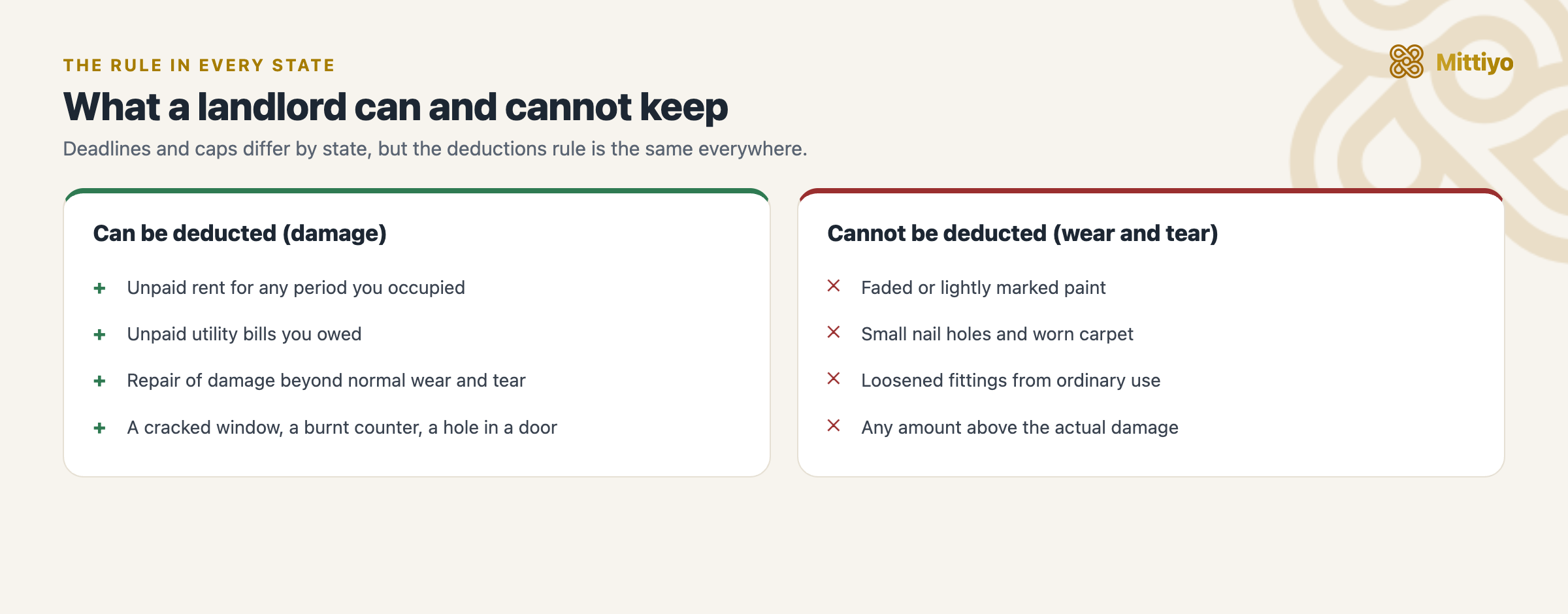
A landlord can deduct for unpaid rent, unpaid utility bills you owed, and the cost of repairing damage you caused beyond normal wear and tear. A landlord cannot deduct for normal wear and tear, which is the ordinary deterioration of simply living somewhere.
The line between the two settles most disputes, so it is worth being concrete:
- Wear and tear (landlord’s cost): faded or lightly marked paint, small nail holes, worn carpet, loosened fittings from ordinary use.
- Damage (can be deducted): a cracked window, a burnt or deeply stained countertop, a hole in a door, a broken appliance, pet damage where pets were not allowed.
The test is roughly: would this have happened anyway from normal living, or did something specific cause it? A full set of dated move-in and move-out photos is what proves which side of the line a mark falls on.
The playbook that works in every state
Whatever your state, the same handful of steps gives you the best chance of a full, on-time refund:
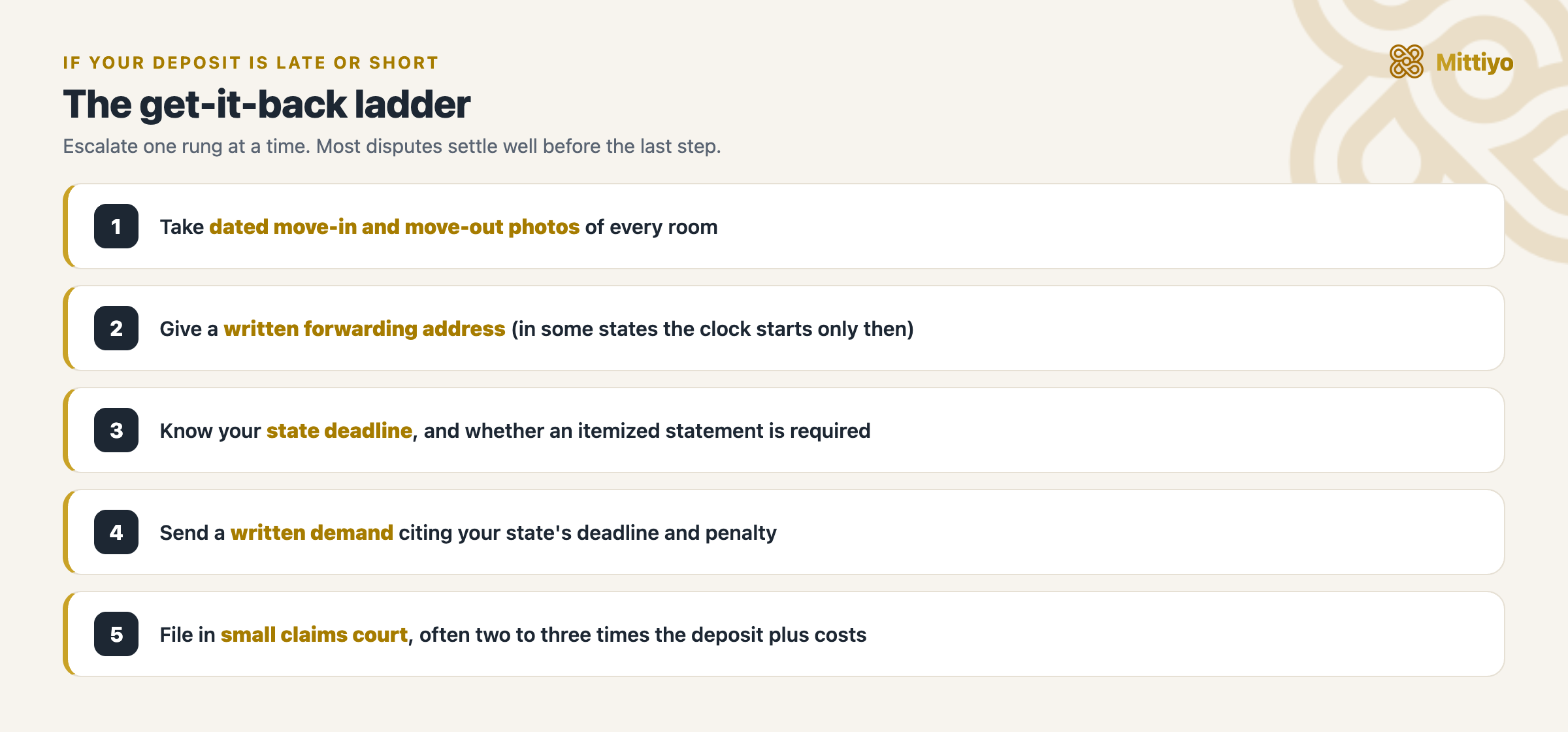
- Document the unit at move-in and move-out. Dated photos and video of every room, plus a signed condition checklist if your state uses one (Washington actually requires a move-in checklist, or the landlord can owe the whole deposit back).
- Give a written forwarding address when you leave. In Texas and Ohio the landlord’s deadline does not even start until you do. Keep a copy.
- Know your deadline. Mark the date the landlord’s clock runs out (use the tool above), and note whether your state requires an itemized statement of deductions.
- Send a written demand if it is late. A short, factual message citing your state’s deadline and penalty resolves many cases on its own.
- Use small claims court if needed. It is built for people without a lawyer, filing fees are low, and most states let you recover two to three times the deposit plus costs when the landlord acted in bad faith.
How to write a security-deposit demand letter
A demand letter recovers most deposits without anyone setting foot in a courtroom. It shows the landlord you know the law, it creates a paper trail, and in many places a court expects you to have tried it first. Keep it short, factual, and calm. Send it by a method you can prove, email plus certified mail is ideal, and give a firm, short deadline.
Pick your state and fill in your details. The letter builds itself with the right statute, court, and penalty for that state. Copy it, then email or post it.
Pick your state above to build your letter.
This is a template to adapt, not legal advice. Keep a copy and send it so you can prove delivery (email, or post with tracking).
Attach your dated move-out photos and your proof of paying the deposit. Most of the letter’s power is in two details: naming the exact statute and deadline, and making clear you are ready to file.
Taking your landlord to small claims court
Small claims court exists for exactly this kind of dispute: money too small to justify a lawyer. You do not need one, the filing fee is modest (commonly $30 to $100), and the whole process is built for ordinary people.
- Where to file. Usually the county or district where the property sits, or where the landlord lives. Each state guide above links its small-claims court.
- The dollar limit. Every state caps small-claims amounts, from a few thousand dollars up to $20,000 (Texas). A deposit dispute almost always fits.
- What to bring. Your lease, proof you paid the deposit, your dated move-in and move-out photos, your written forwarding address, the landlord’s itemized statement (or proof that none arrived), and a copy of your demand letter.
- What you can win. The deposit itself, plus, where the landlord acted in bad faith, the statutory penalty (often two to three times the amount) and your court costs.
The landlord usually knows all of this too, which is exactly why a credible demand letter settles most cases before a hearing is ever held.
Common landlord tactics, and how to beat them
Most wrongly withheld deposits come down to a short list of moves. None of them survive an itemized-statement demand and a set of dated photos.
- The blanket cleaning or painting fee. Charging every departing tenant a flat “cleaning” or “repainting” fee, with no actual damage, is not allowed. Routine cleaning and repainting for ordinary wear are the landlord’s cost. Ask for the itemized basis; usually there is none.
- Carpet or paint “replacement.” Carpet and paint have a limited useful life. A landlord cannot bill you for a brand-new carpet to replace one that was already years old, at most the prorated value of its remaining life, and only if you actually damaged it.
- Vague, round-number deductions. “$500 for repairs” with no breakdown fails the itemization rule almost everywhere. Demand the itemized list and the receipts behind it.
- Going silent. Ignoring you does not pause the clock. In most states, missing the deadline forfeits the landlord’s right to deduct anything at all, so silence becomes your strongest argument.
- “The lease says I can keep it.” A lease cannot sign away your statutory deposit rights. A clause that tries to is void.
Deposit rules in 18 states at a glance
Click your state for the full guide, including the exact statute, the itemization rules, and how to get your money back.
| State | Max deposit | Return deadline | Interest to tenant? | Bad-faith penalty |
|---|---|---|---|---|
| Arizona | 1.5 months | 14 business days | No | 2x wrongfully withheld |
| California | 1 month (2 for some small landlords) | 21 days | No state rule | Up to 2x the deposit |
| Colorado | 1 month (since 2026) | 1 month, up to 60 | No | 3x wrongfully withheld |
| Florida | No limit | 15 days / 30-day claim notice | Only if in an interest account | Forfeits deductions if late |
| Georgia | 2 months | 30 days | No | 3x improperly withheld |
| Illinois | No limit | 30 days to itemize / 45 to refund | 25+ unit buildings | 2x the deposit |
| Maryland | 1 month (since Oct 2024) | 45 days | Yes | Up to 3x withheld |
| Massachusetts | 1 month | 30 days | Yes, 5% if 1+ year | 3x the deposit + fees |
| Michigan | 1.5 months | 30 days | No | 2x amount retained |
| Minnesota | No limit | 21 days | Yes, 1% | 2x + $500 bad faith |
| New Jersey | 1.5 months | 30 days | Yes, annually | Double wrongfully withheld |
| New York | 1 month | 14 days | 6+ unit buildings | Up to 2x the deposit |
| North Carolina | 1.5 to 2 months | 30 days | No | Voids right to keep it |
| Ohio | No limit | 30 days | 5% on larger deposits, 6+ months | 2x wrongfully withheld + fees |
| Pennsylvania | 2 months yr 1, 1 after | 30 days | After 2 years, over $100 | Double the excess |
| Texas | No limit | 30 days | No | $100 + 3x + fees |
| Virginia | 2 months | 45 days | No | Deposit + damages + fees |
| Washington | No limit (Seattle caps it) | 30 days | Not required | Deposit + up to 2x for refusal |
More states are being added. If your state is not here yet, the playbook above still applies, and your state’s landlord-tenant statute or attorney general site has the specifics.
More free tools for renters
You do not need a lawyer to protect your deposit. These free tools do the routine work for you:
- Security deposit interest calculator shows whether your state owes you interest on your deposit, and estimates how much.
- Notice to vacate generator builds a clean move-out letter that gives written notice and sets up your deposit return.
- Rent affordability calculator finds a comfortable rent using the 30 percent rule.
See the whole set on the free tools for renters page.
Key takeaways
- Security deposit rules are set by your state, so the return deadline, the cap, and the penalties change across state lines. Use the lookup tool to check yours.
- A deposit is refundable minus legitimate, documented deductions. Normal wear and tear is never one of them.
- Most states require a written, itemized statement of deductions within the deadline, and several make the landlord forfeit deductions if they miss it.
- Document the unit and give a written forwarding address. These two habits defeat the most common reasons deposits go missing.
- If a landlord withholds in bad faith, most states let you recover two to three times the deposit plus attorney fees, often through small claims court.
This guide is general information, not legal advice. Landlord-tenant law changes and varies by city as well as state; confirm your situation against your state’s statute (linked in each state guide) or a local attorney. Last reviewed July 2026.
Renting somewhere new?
know.place maps honest, structured experiences of specific buildings, the rent, deposit, water, and power, from people who have actually lived there, so you can vet a place before you sign.
References and resources
For your state’s exact statute, return deadline, penalty, and small-claims court, open your state guide above; each links its primary sources. For federal and cross-state resources:
- Tenant rights, laws, and protections, US Department of Housing and Urban Development (HUD)
- What rights do I have as a tenant or renter?, HUD tenant FAQ
- Your state’s landlord-tenant statute and Attorney General or state-courts self-help site (linked in each state guide) are the authoritative source for your situation.
Related guides: Apartment viewing checklist · Questions to ask a landlord before you rent · How much rent can you afford? · How to spot a rental scam